
Pygmalion's Prize
2008-2009
“Now in the while by wondrous art an image he did grave
Of such proportion, shape and grace as nature never gave
Nor can to any woman give. In this work he took
A certain love. The look of it was right a maidens’s look,
And such a one that ye would believe had life and that
Would movèd be, if womanhood and reverence letted not.
So artificial was the work. He wond’reth at his art
And of his counterfeited corse conceiveth love in heart.”
From Ovid’s Metamorphoses, The tenth book, The Story of Pygmalion
Translated by Arthur Golden
First Prize - After the painting "Venus of Urbino" by Titian, 1534
The Venus of Urbino (also known as Reclining Venus) is an oil painting by Italian painter Titian, depicting a nude young woman, traditionally identified with the goddess Venus, reclining on a couch or bed in the sumptuous surroundings of a Renaissance palace. Work on the painting seems to have begun anywhere from 1532 or 1534, and was perhaps completed in 1534, but not sold until 1538. It is currently held in the Galleria degli Uffizi in Florence.
The figure’s pose derives from the Dresden Venus made around 1510–11, traditionally attributed to Giorgione but with the landscape completed by Titian. In this painting, Titian places Venus indoors, meets the viewer’s gaze, and makes her sensuality explicit. Iconographic interpretations of the painting among art historians fall into two groups; both agree that the painting has a powerful erotic charge, but beyond that, it is seen either as a portrait of a courtesan, perhaps Zaffetta, or as a painting celebrating the marriage of its first owner (who according to some may not have commissioned it).
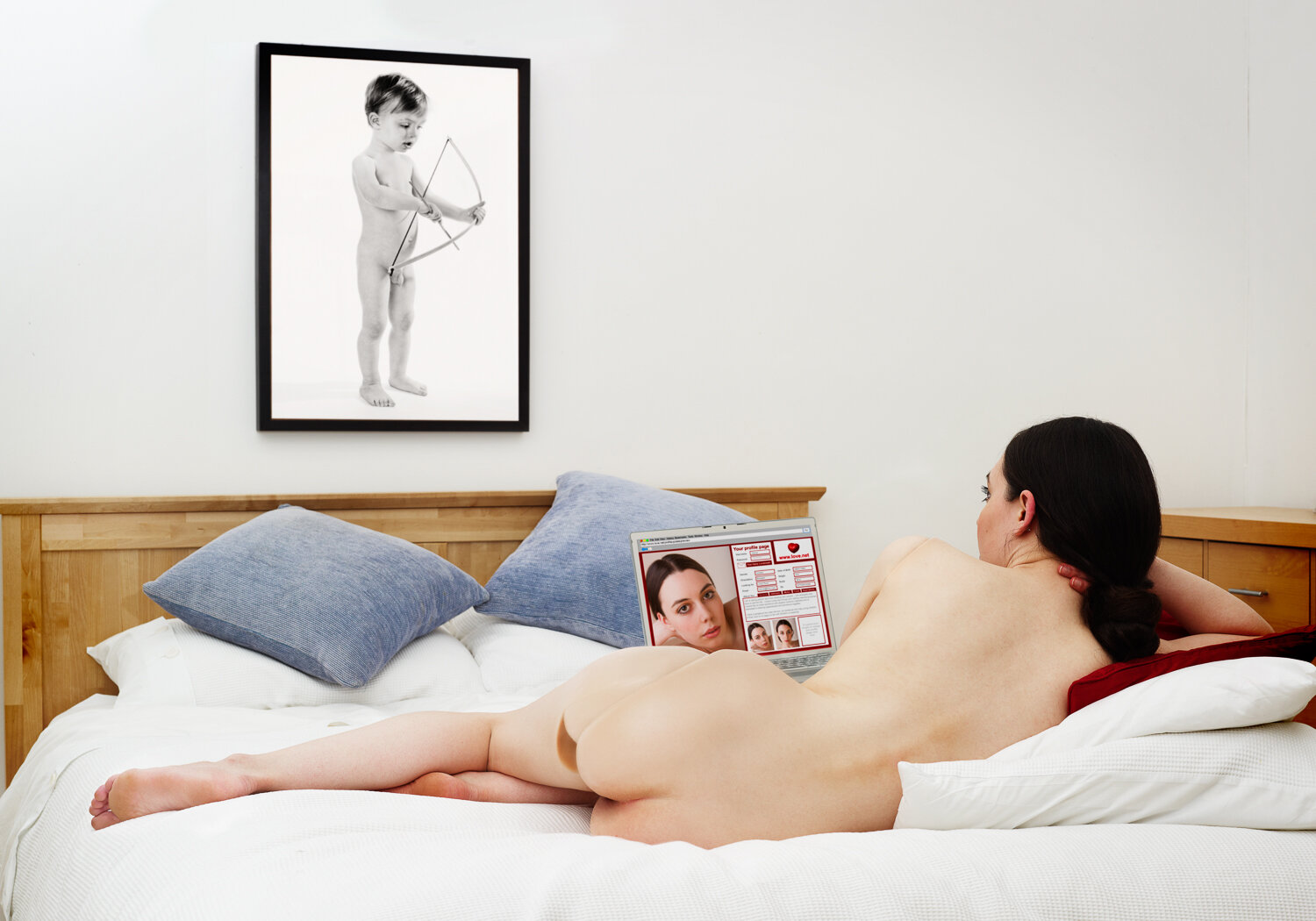
Second Prize - After the painting "The Rokeby Venus" by Velasquez 1651
The Rokeby Venus; also known as The Toilet of Venus, Venus at her Mirror, Venus and Cupid and, in Spanish, La Venus del espejo) is a painting by Diego Velázquez, the leading artist of the Spanish Golden Age. Completed between 1647 and 1651, and probably painted during the artist's visit to Italy, the work depicts the goddess Venus in a sensual pose, lying on a bed with her back facing the viewer, and looking into a mirror held by the Roman god of physical love, her son Cupid. The painting is in the National Gallery, London.
Numerous works, from the ancient to the baroque, have been cited as sources of inspiration for Velázquez. The nude Venuses of the Italian painters, such as Giorgione's Sleeping Venus (c. 1510) and Titian's Venus of Urbino (1538), were the main precedents. In this work, Velázquez combined two established poses for Venus: recumbent on a couch or a bed, and gazing at a mirror. She is often described as looking at herself in the mirror, although this is physically impossible since viewers can see her face reflected in their direction. This phenomenon is known as the Venus effect. In some ways the painting represents a pictorial departure, through its central use of a mirror, and because it shows the body of Venus turned away from the observer of the painting.
The Rokeby Venus is the only surviving female nude by Velázquez. Nudes were extremely rare in seventeenth-century Spanish art, which was policed actively by members of the Spanish Inquisition. Despite this, nudes by foreign artists were keenly collected by the court circle, and this painting was hung in the houses of Spanish courtiers until 1813, when it was brought to England to hang in Rokeby Park, Yorkshire. In 1906, the painting was purchased by National Art Collections Fund for the National Gallery, London. Although it was attacked and badly damaged in 1914 by Canadian suffragette Mary Richardson, it soon was fully restored and returned to display. It was attacked again and its protective glass smashed by Just Stop Oil in 2023.

Third Prize - After the painting Olympia by Manet 1863
Olympia is an 1863 oil painting by Édouard Manet, depicting a nude white woman ("Olympia") lying on a bed being attended to by a black maid. The French government acquired the painting in 1890 after a public subscription organized by Claude Monet. The painting is now in the Musée d'Orsay, Paris.
The figure of Olympia was modeled by Victorine Meurent, and that of her servant by Laure. Olympia's confrontational gaze caused shock and controversy when the painting was first exhibited at the 1865 Paris Salon, especially because a number of details in the picture identified her as a prostitute.
The title of the painting is generally attributed to Manet's close friend Zacharie Astruc, an art critic and artist, since an excerpt from one of Astruc's poems was included in the catalogue entry along with Olympia when it was first exhibited in 1865.