Patrimony Part II: The Mexican Standoff
Reflecting further on the series of images I made on the issue of male suicide, and also the test image I made under the heading Patrimony, it occurred to me there was more to explore under that heading and in that vein. I started from the position of my own experience of abused male power and violence, and some of the impact that legacy had on me. But of course, the literal definition of Patriarchy is that male power, status and wealth is passed down the paternal line thus prioritising men over women. Patrimony is the process by which that happens, the legacy and inheritance passed down from one generation of men to the next.

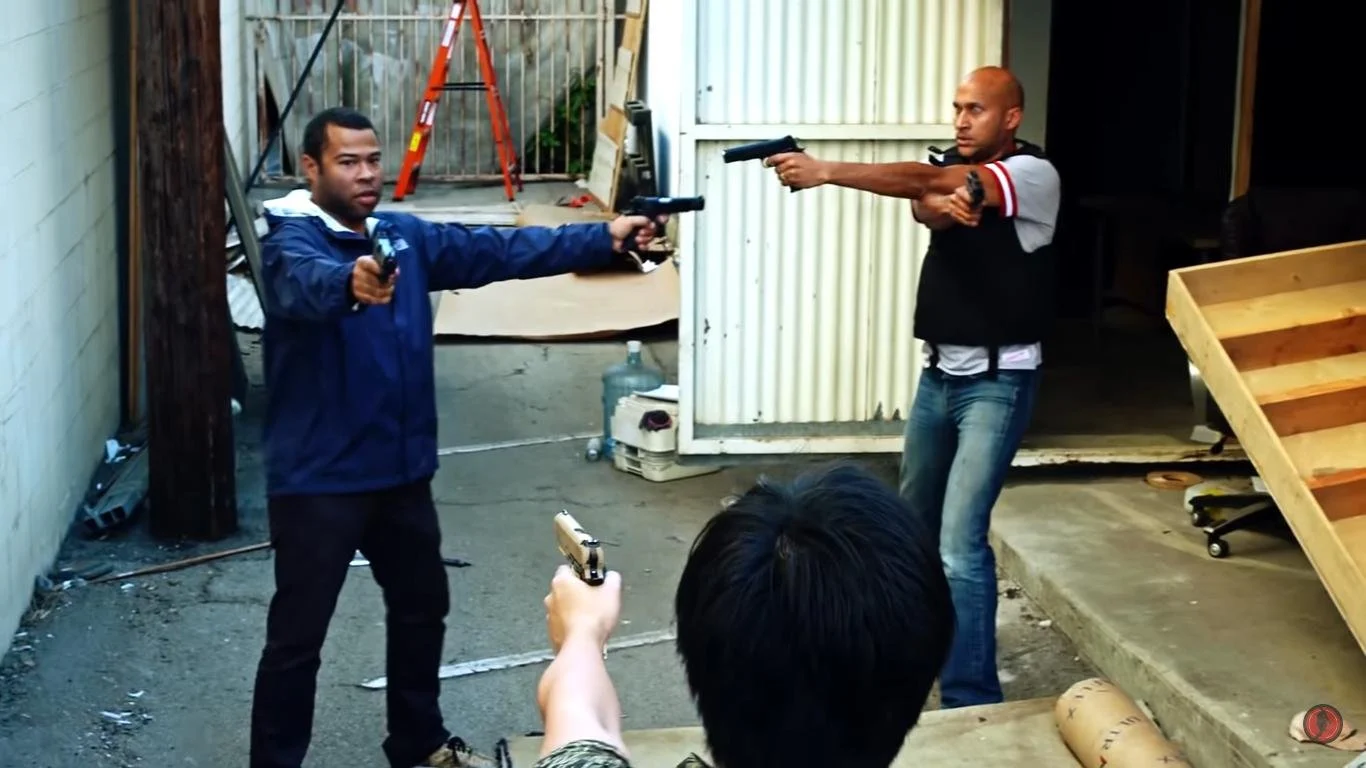
I therefore decided I wanted to make a series of images exploring this universal, rather than only personal notion of men passing on and perpetuating “male” traits that help to maintain the patriarchal order but certainly to me can also be considered problematic. Although as my influences and references, my inspiration can come from anywhere – a chance encounter or observation in the street, something heard on the radio or seen on a screen - I don’t recall exactly where the idea for producing a Mexican Standoff image came from. It’s quite possible that it is when I was thinking and writing about Action Heroes and Action films. But wherever the inspiration was sparked, the vignette of two or more protagonists threatening each other at gun point in a zero-sum, lose-lose moebius-strip of misery seemed like a perfect metaphor the perpetuation of the sort of toxic and self-destructive male behaviour I wanted to explore. The fact that it is such a commonly recurring motif in films made largely for a male audience and has become such a trop that it has widely acknowledge shorthand label, suggests that others have found it also to be a useful vehicle for exploring male violence as an attribute of problematised masculinity.
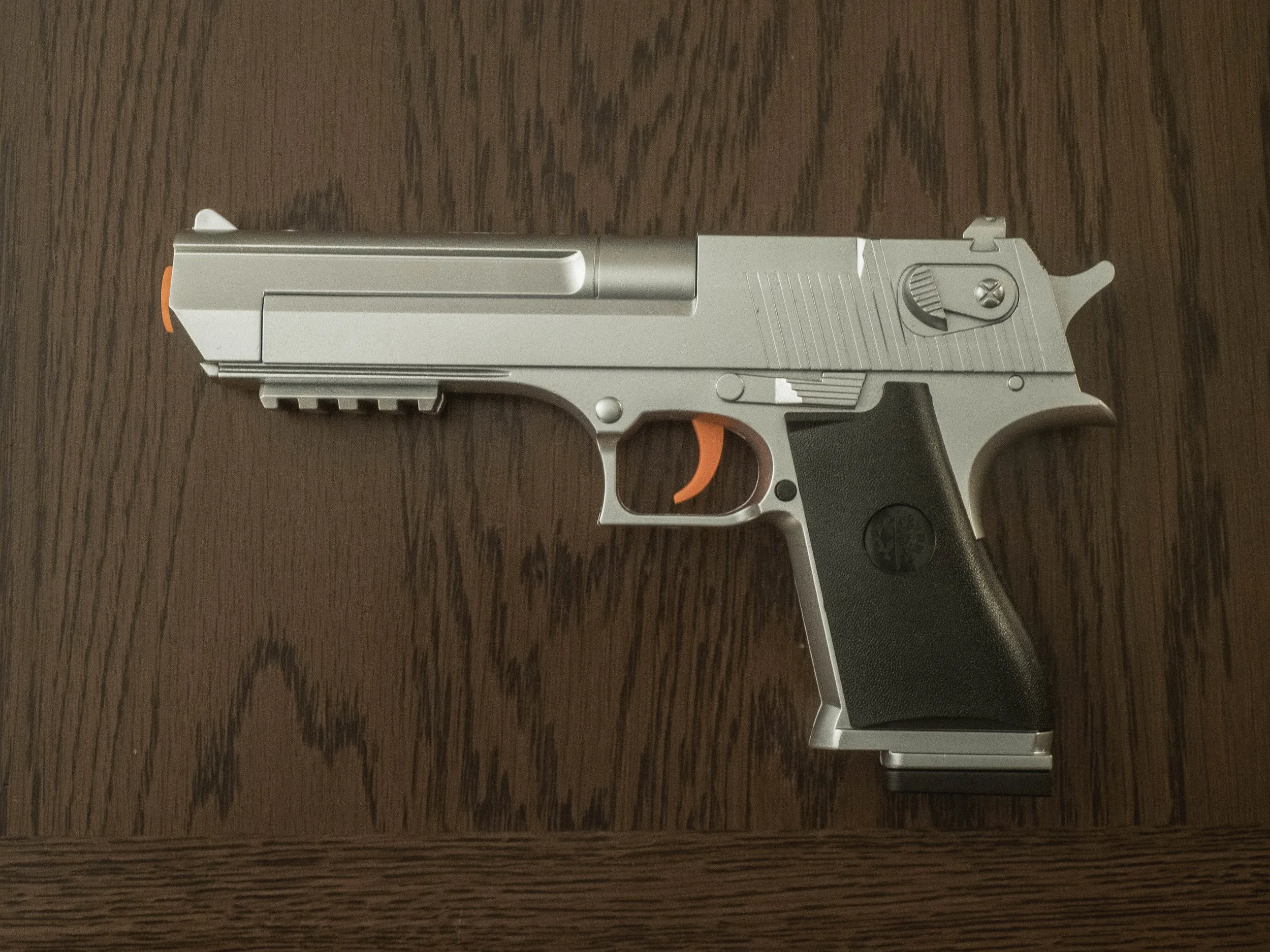
Anticipating my production of this image, I also began researching the options for an affordable but believable replica gun. There were many commercially available props for the purposes of film and TV, but in the end, I settled on a much more economic (£15) option from amazon, a plastic “educational” (?!) toy on Amazon that fired foam rubber pellets. It was accurate enough a copy that I felt confident with digital enhancement/manipulation I could make it appear convincing enough for my purposes.
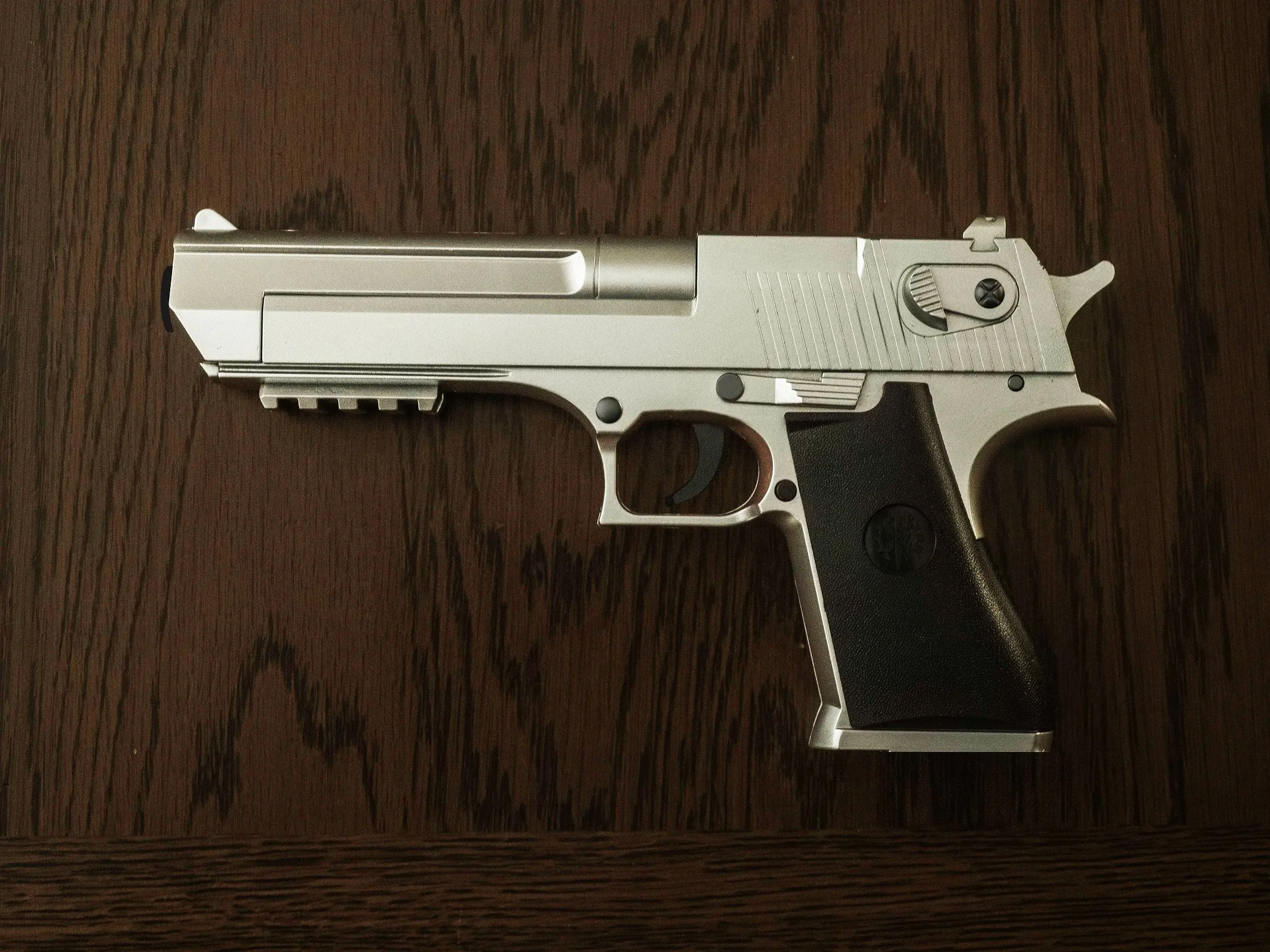
Of course, as is the signature of my work, I will use digital manipulation to actualise the subject matter of the metaphor while hoping to retain what is familiar and recognisable about the symbolism. In doing so hopefully open a door to the audience that takes them beneath the surface of the represented.
Incidentally, as I paused from writing this to attend to the washing up and put on the radio, it just so happened that that a very apt programme was playing. It was an episode of the fascinating social science documentary serious Child, which explores the science of child development. This episode was centred on the emotion of anger and at one point dealt with how it was “gendered” in childhood and beyond with different expectations of behaviour and behaviour for males and females.
In relation to of the sort of social Patrimony I refer to above, I found a perfect example in the discussion around criminal hearings where male judges have given verdicts of manslaughter (rather than murder) for men who killed their unfaithful partners in “crimes of passion”, arguing that these killers were “provoked” and therefore entitled to the less severe judgement! And should it need spelling out, such scenarios not only add to the normalisation and justification of male violence as a method of exercising male power, but they also reinforce the patriarchal notion that a man’s female partner is in some way his property.
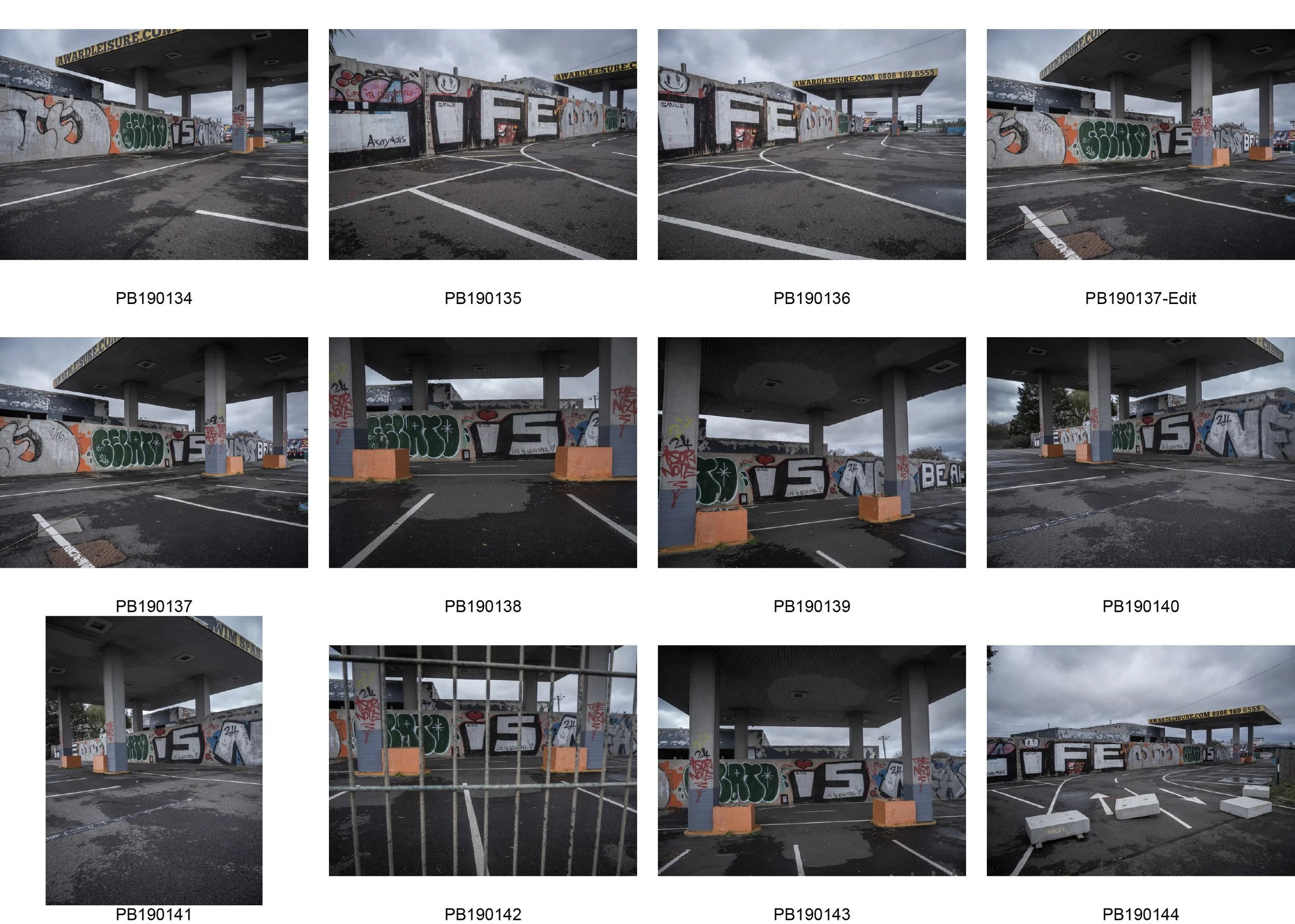
Feeling confident that my first test image had to mileage to be developed, reshot, and recreated with more complexity and technical skill, I wanted next to find a suitable location for a Mexican Standoff image. Fortunately, there happens to be an abandoned commercial property very near to me that I thought might fit the bill. First, I visited it in daylight taking a selection of test shots so that I could understand how the space appeared in photographic representation, from different angles and to get my aesthetic and special bearings as it were. I had always suspected that I would prefer to shoot at this location at night however and while the daylight shots confirmed that the location could work for me - providing a sense of urban decay - I wanted to return at night.
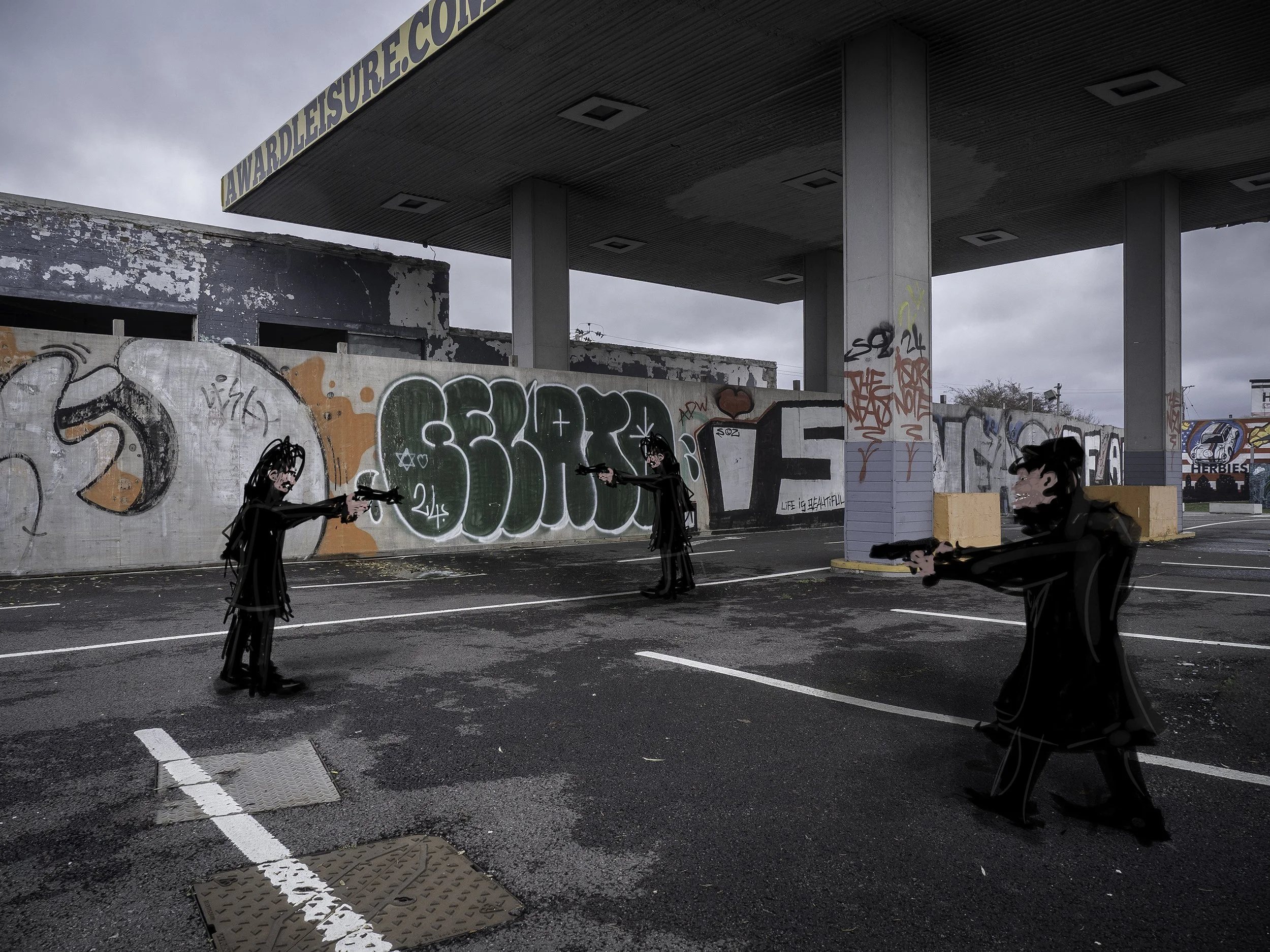
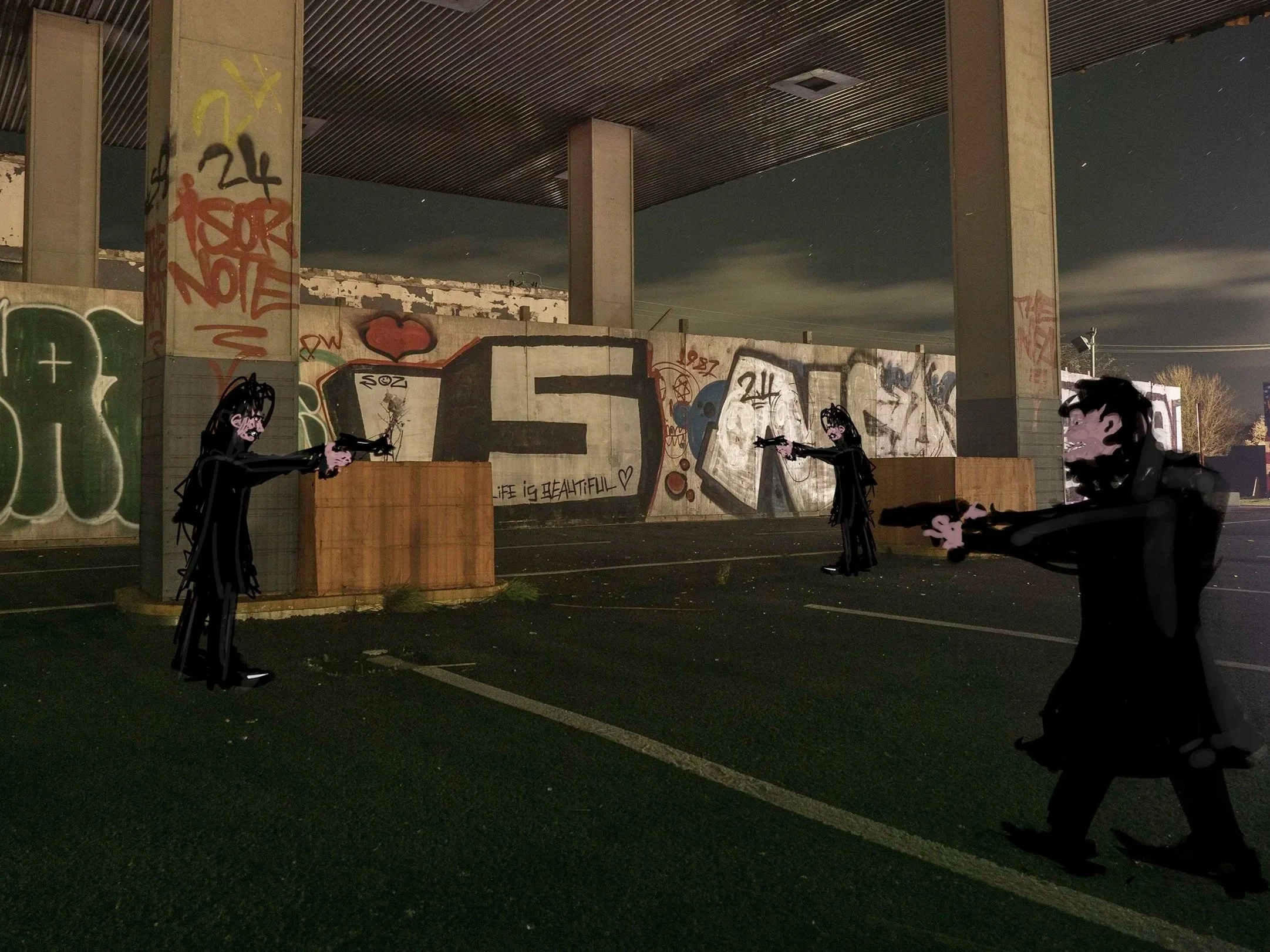
In the meantime, I set about using my graphics tablet and Photoshop to sketch in digitally three shooters in deadly triangulation representing the Mexican Standoff which I will eventually represent with a human subject photographically. I knew that I could also later recycle these sketches once I had some nighttime test shots which, ultimately, I did as you can see above.
Returning to the location a few days later, but in the evening, I grabbed a couple of long exposure shots to take home and review. I could have shot more images but at this stage I just needed enough to satisfy myself the location could work at night, and because each exposure took so long, I left it at this for now. And in fact, those two near-identical images were enough to confirm that a long exposure shot of that location at night had exactly the sort of look and atmosphere that I had hoped it would have.
To achieve the impact and meaning I am seeking, I will use the same subject as all three participants in my staged Mexican Standoff. Due to the nature of long exposure photography, especially when employing flash for localised illumination it may be possible to create an image in camera with the same subject in three different positions, each lit by flash individually.
If I was shooting on film, prior to the age of digitisation and digital manipulation, this in camera compositing might be my best option. A master printer might be able to achieve the same results in the darkroom using masks, but that would mean relinquishing part of the creative process and part of my creative control to the printer. Fortunately, with photographic and image manipulation technology as it is today, I also have the option of shooting the same subject in various positions, again in each case lit individually by flash and then composite an image using the elements of my choosing.
As an aside, for much of my photographic career I have been frustrated by a slight misrepresentation of the medium of photography. It is a fallacy often voiced by practitioners and less surprisingly by non-practicing audiences and consumers of photography. It is an understandable fallacy as the word photograph translates as something like light-writing. I have heard so many photographers and critics of photography opine about the medium’s ability to capture, represent and celebrate light (and perhaps in relation to its binary opposite of dark).
But while light (and equally dark) is indeed fundamental to photography, it is too often forgotten that the so often celebrated light is only a contingent factor of time. Photography is just as much a medium of time as it is light.
Through reciprocal adjustment of the lens aperture (size of the hole that admits light into the camera and onto the recording media) and shutter speed (the amount of time that the light admitted through the aperture is allowed to affect the recording media) one can achieve the same total amount of light being captured, but with drastically different results. In fact, the understanding of this phenomenon is one of the critical concepts for a photographer to grasp and utilise to be able to use the potential of the medium to express and communicate in different ways.
Similarly, I tend to be sceptical of claims that photography’s power lies in its ability to reproduce what the human eye sees. I would argue that on the contrary, while in many ways photography cannot match the sophistication of the human eye in seeing, it does on the other hand allow us to see a recognisable world beyond our natural visual capabilities. Whether it is high-speed photography that in a thousandth of a second can freeze the wings of a hummingbird, twenty-six still images captured and replayed each second to constitute a moving image, or a long exposure photograph that reveals by a gradual additive process the beauty in the night that we could not see with the human eye, photography exploiting both light and time provides additional dimensions to the human visual world. Light and time, and greater than the sum of these parts.