Our Father, who art in trousers...
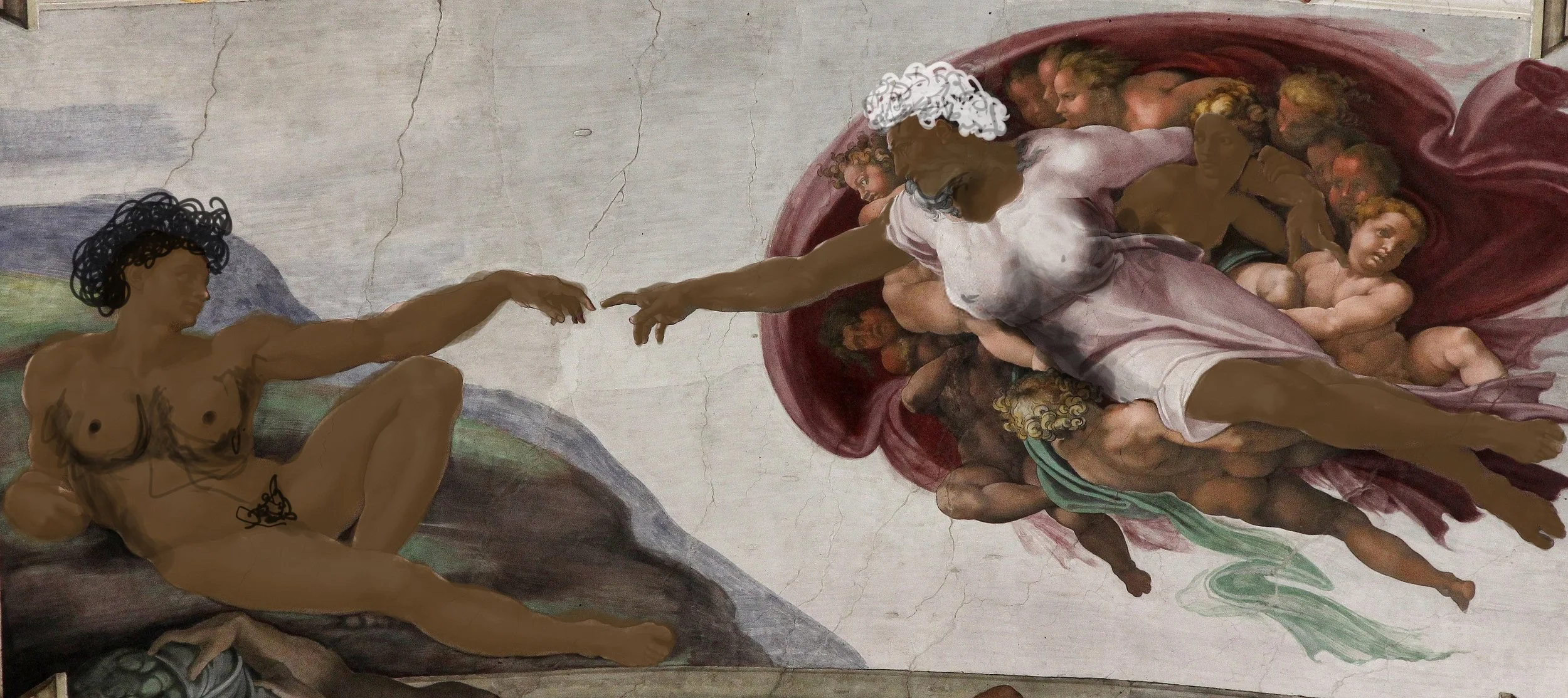
From “The Creation of Adam” to “Black Mother God Creates First Black Eve” (After an excerpt from Michalangelo’s Sistene Chapel Mural)
Twice on Sunday’s and at various other times during the week, one can witness a procession of impeccably dressed men, women, and children of all ages walking first to, and then from, their destination just a few hundred meters up the road from my flat.
I currently live in a large village about ten miles outside of a prestigious university city in East Anglia. This village which is too small to have the anonymity of a town, but too large to have the more intimate feel of a smaller village, was at one time the second largest town outside of the county town (and now city) itself. The built environment is comprised of properties constructed several hundred years ago, new developments still under construction, and everything in between. Likewise, some of the still resident families have village roots that go back many generations while others are recent newcomers (as am I).
The destination of those select locals, in all their finery, is one of the two Baptist Chapels in the village, the more elite of the two in fact; the Particular Baptist Chapel. Now, being an atheist myself, I had to research the various relevant creeds to gain an insight into the differences between the two Baptist denominations housed locally. I discovered that whereas the General Baptist church believe that Jesus died for all our sins; to redeem us all, the Particular Baptists believe only those that have embraced the faith fully and demonstrated this by undergoing a submersive baptism will be selected for salvation.
My interest in the theological preferences of my neighbours stemmed simply from seeing them in their “Sunday best” (regardless of the day) as they walked past my flat to attend and then return from service at the chapel. Had I observed this phenomenon only once, I might not have dwelt on it but seeing it two or three times a week over a period of more than two years now, I was eventually struck by something: The formal clothes worn by adults and children alike were heavily gender coded.
The men and even the boys invariably wear two- or three-piece trouser suits and ties, while the women and girls (without fail) wear dresses or skirts and often also sport hats. Teenage girls and women wear at least court shoes or a kitten heel if not a full-height heeled shoe, while young female children still wear formal shoes.
Now, there are no doubt certain places, and certain times in recent history, where this (observed) dress-code might be easy to write off as being “just” formal dress. On the other hand, having witnessed this clothing-encoded gender binary being persistently and consistently expressed, I came to realise that the normal (usual) expressions of this “group” (at least when at worship) was beyond, or outside of the “normal” and less rigidly binary presentation of the wider population.
This realisation in turn caused me to reflect upon and wonder if the culturally expressed and seemingly normalised gender binary was at least implicitly if not explicitly a consequence of a monotheistic, patriarchal theology.
Having frequently worked alongside women in an office or client-facing environments where formal dress has been the norm, I feel that I might have been just as likely to see a female colleague in trousers, as I would see them in a skirt or a dress. And of course, in other environments such as schools or in the hospitality industry where women and girls might have once been expected to wear a skirt, trousers are now largely normalised as an alternative.
So, the residing impression I have of the participants of these pious processions is of people, and a patriarchal faith, that perpetuate at the very least the expression of gender as binary. And although I have said previously, I believe that human biological sex is fundamentally a binary, I see gender as a much more nuanced biopsychosocial phenomenon. From this position, clothing and other cosmetic adjustments or adornments can be an opportunity for an individual to explore, express and emphasise different aspects of their personal identity, whether this might be emphasising parts of themselves which they consider, or, in ways which are considered, “male” or “female”.
Current popular culture and media; our proxies for tribe and for community, and our erstwhile social mirror, not only tend to reflect norms of binary gender expression, but in doing so reinforce what could be described as “emphasised” femininity and hegemonic masculinity. But even in that realm, there are representations of the marginal and greater diversity and nuance available than was observable within my local Particular Baptist congregation.
I therefore find it difficult not consider to what significant degree (surely some) that the patriarchal, monotheistic religions (and their various denominations) being foundational in post-roman anglophone culture are responsible for our problematic subordination of women and equally problematic exaltation of men. It was already my intention to explore this possibility in my research by practice as a result of my more global observations so it was particularly gratifying to find such compelling raw data literally on my doorstep.
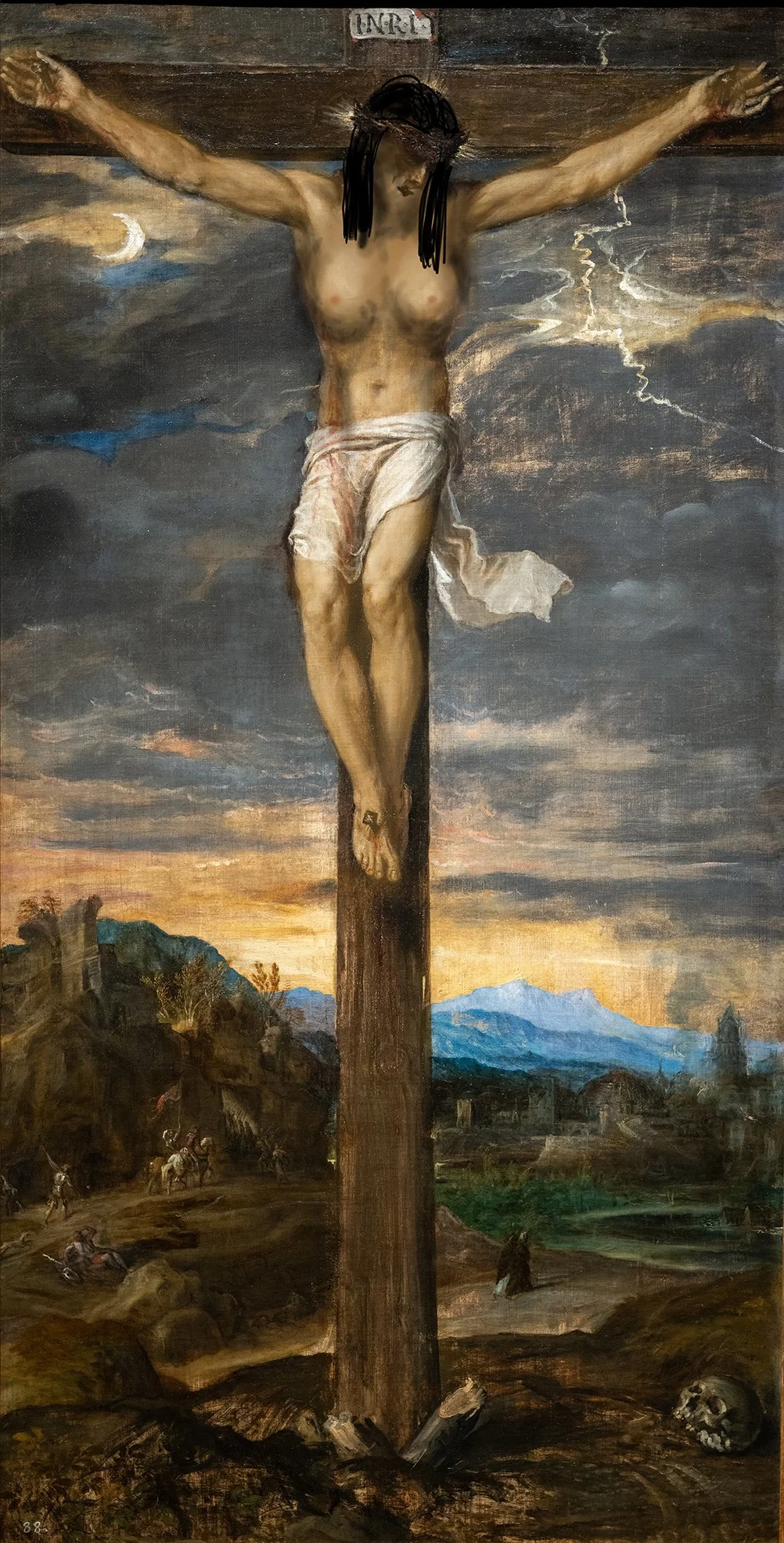
From a white male saviour, dying for our sins, to a brown woman in his place (after Titians Christ Crucified).