From A to Z (Assault to Zofia), Part 3: An anti-portrait, primordial selfies and a social archive
Just as I’d hoped, having explained my booking/itinerary error to the assistant at the National Portrait Gallery, he was happy to take my booking confirmation and issue me a ticket for admittance immediately. When planning this day of gallery visits, I knew that the Portrait Prize was least directly relevant to my own practice and area of research and that it was likely I’d have least to say about this exhibition. My expectations were confirmed as I took in the painstakingly curated shortlisted images which were all good and worthy of merit; which were diverse in the photographers and subjects they represented, but ultimately to me at least, were largely forgettable.
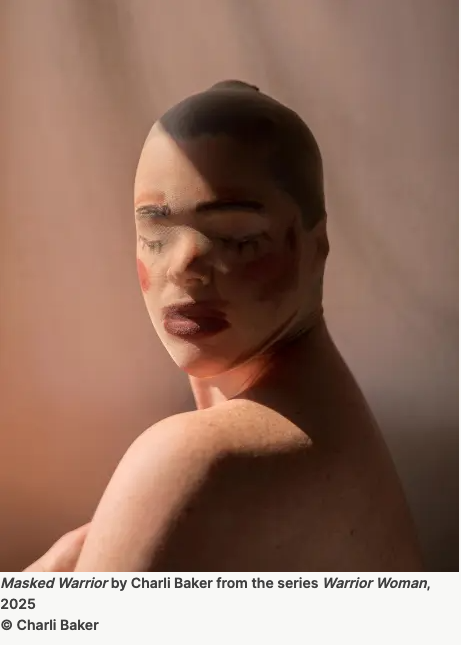
This indifferent response is usual for my visits to the annual exhibitions of this competition and perhaps one reason I keep returning is the hope that one day I might be more pleasantly surprised. I’m just not really sure what most of these are images are for, or what it is they do that hasn’t already been done. The image that came closest to that for me this year was almost an anti-portrait: Masked Warrior by Charli Baker from her series Warrior Women. And it is that image I selected as my choice for the People’s Pick award. There were other images on my personal shortlist and which liked for specific reasons, although in the end, Charli Baker’s stood out for me as the most innovative and meaningful.
I liked Abe by Christopher Owens, and Molly and Amber by Juliet Klottrup for their depictions of a new generation shunning gender stereotypes, Benji by Tamsyn Ward and Gary the Window Cleaner by Deborah Hurford Brown were both relatable and earthy but compassionate in their humour, In the Agony Hole by Margaux Revol and We Dare to Hug by Luan Davide were moving and felt important dealing with the under-reported stories respectively of the suffering caused by Endometritis and the loving element of homosexual relationships when popular media seems to focus too much on the sexual element (how can two people loving each other be wrong?) of same-sex relationships.
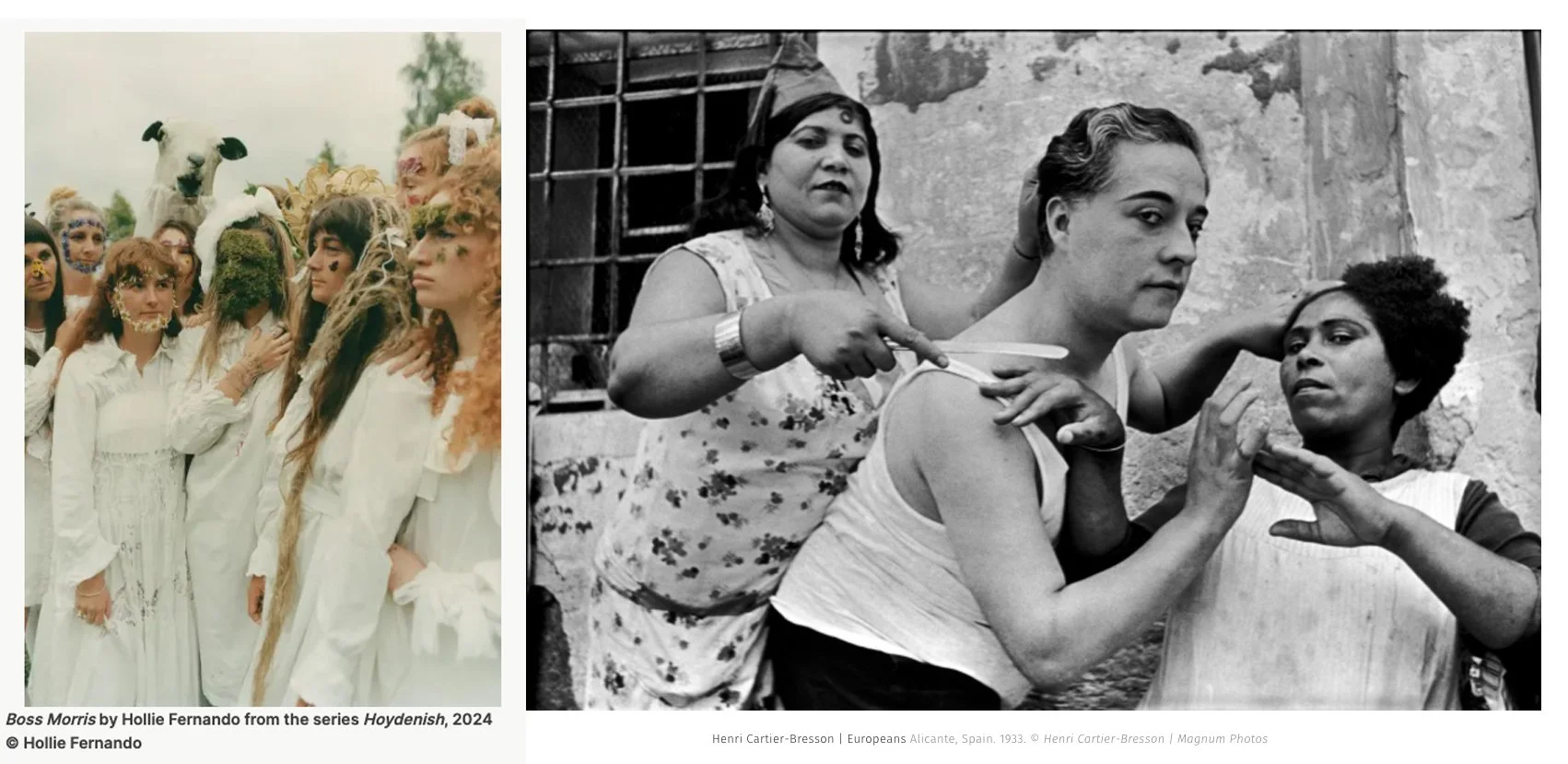
I could say more about other images that I liked, or of those that left me flat, but being fairly ambivalent I’ll only go on to say I didn’t find the image selected for first prize (Boss Morris by Hollie Fernando) to be particularly interesting or for that matter deserving of the award. The judges cited the fact that they found the composition and relational dynamics drew them into the picture. Personally, I found neither to be the case and although the subject matter was curious, the image seemed more like it belonged in a set of editorial images and it was questionable to even classify it as a portrait. But rather than expend more energy on explaining why in my eyes the winning image fails to do what the judges claim, I will simply show an image that succeeds in these effects: Europeans by Henri Cartier Bresson from 1933.
As I said, for me Charli Baker’s self-anti-portrait was the most interesting. It seemed the most modern in its healthy and especially appropriate 21st Century scepticism of visual media’s ability to truthfully represent identity. And while there is clearly an irony in this image in which she masks her face with a stocking and painted-on features, it seems to me to be more honest for the act of its deception, drawing attention to the less visible masks hiding the true complexity of so many other “representational” portraits. In her statement about this image Charli says, “Perhaps I was a warrior in a previous life”. Even before reading that statement the image struck a chord with me, clearly, she was drawing attention to the tension between the surface and the interior, the simplistic superficial and the complex corporeal. It rung true for me as a contemporary “portrait”, and first and foremost, when I initially saw it, the image drew me in; it piqued my curiosity, made me smile because of its transgression and demanded I engage with it.
The use of the stocking to mask her actual face of course has connotations of the rudimentary disguise associated with armed robbers of the past (perhaps she was hoping to steal the prize with her image?). And the face painted on the nylon canvas connotes the act of performance both generally (such as theatre where other identities are intrinsically adopted) as well as specifically the performance (as per Judith Butler) of femininity. So, while Baker’s simple nine-word statement supported and added to my reading, it was, as it should be, that the image itself had done the heavy-lifting of communicating meaning and emotion.
Having made my selection for People’s Pick on one of the tablets at the exit/entrance to the exhibition, I made my way out of the National Portrait Gallery and checked the time. When planning my itinerary, I had optimistically identified a return train leaving Kings Cross at around three fifteen. It was now a little before three and it was still a fifteen-minute walk to get to my next destination, the Photographer’s Gallery where there were at least two exhibitions I wanted to see. Briefly I wondered if I should head straight to Kings Cross and save the Photographer’s Gallery for another day, ensuring I caught an off-peak train before four thirty and avoiding the expense of having most likely to buy food and drink while waiting for a later off-peak train in the evening.
I understood that the 100 years of the photo booth show was a relatively small exhibit, and had already decided that I wanted to purchase the exhibition catalogue of Zofia Rydet’s images of domestic Poland for my half-Polish elderly mother, so was hopeful I could squeeze in my final destination. On checking train times, I confirmed there were a couple (one direct, the other a tortuous stopping service) after four, but before the peak period starting. So, in the end, I figured if I headed directly to the Photographer’s Gallery and did not linger there too long, I could still make the short journey north on one of the frequent Victoria Line trains from Oxford Circus to Kings Cross and catch one of my desired return trains.
Although I had been walking with my camera in hand between destinations, Leicester Square and China Town were so busy with visitors and sightseers, that even in such a rich visual environment but under some time pressure now, I wouldn’t have seen the wood for the trees as it were, so the camera stayed by my side as I continued through the familiar and nostalgia laden streets of Soho to Ramillies Street.
On arriving at the Photographer’s Gallery, I confirmed with the assistant at the ticket desk that I could immediately benefit from free access to all exhibits if I purchased annual membership on the spot and completed the brief form required. With the admin attended to, I was directed via the lift to the top floor where the Boris Mikhailov retrospective was sited. However, I knew I wouldn’t be able to do the show justice in the time I had left and I’d seen work of his exhibited in the past, so began instead on the floor below with the tribute to the automatic photo booth, resolving to return to the Mikhailov show on another occasion.
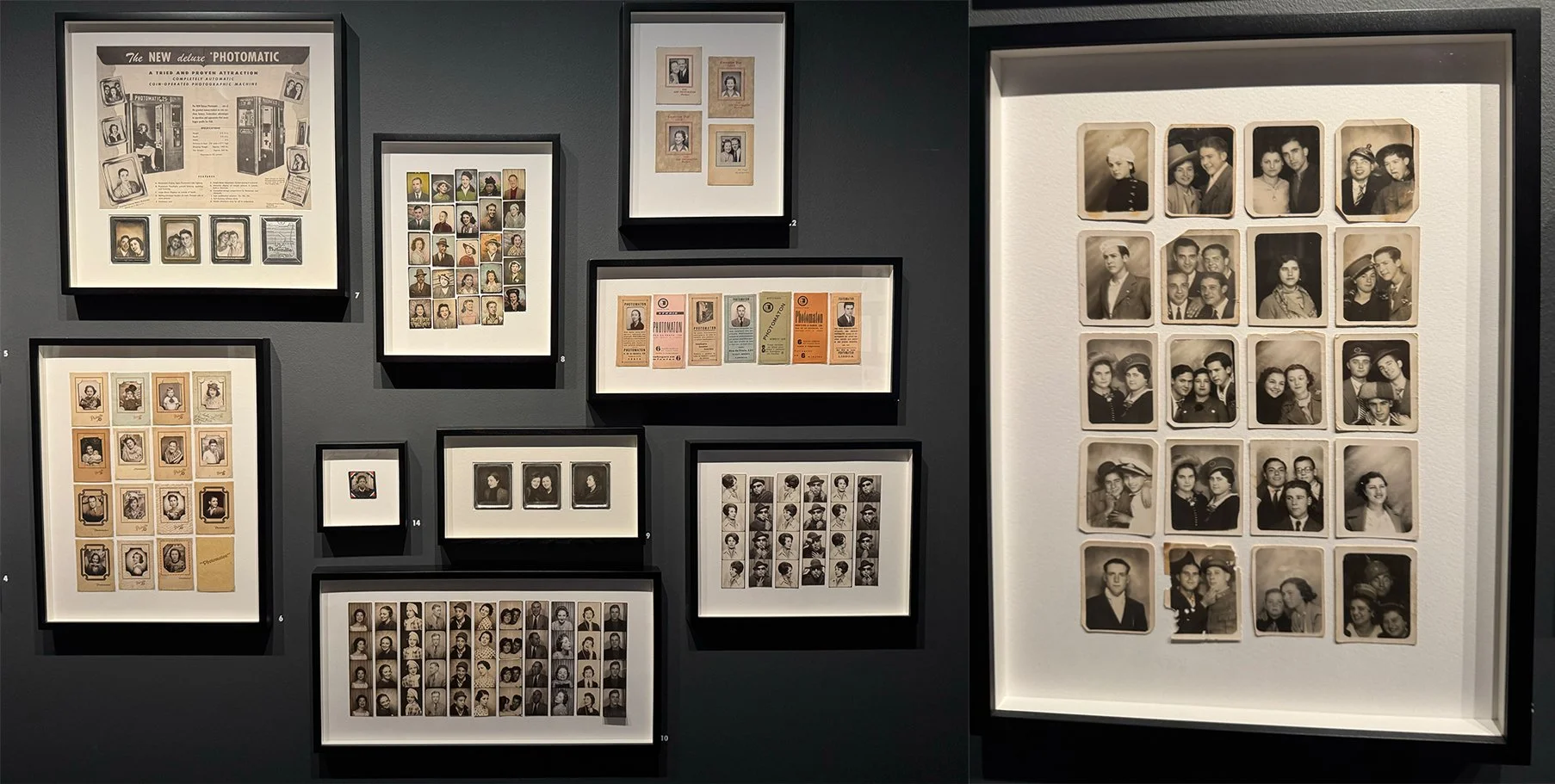
While it was fun to see the technical wizardry of the workings of an analogue photo booth with its tubes of chemicals and mechanical components revealed, already being so familiar with the magic of darkroom processes, I could imagine how this might function anyway and was less interested in this than a lay person might have been; I was there to enjoy the primordial selfies and was glad to discover that the exhibit did not disappoint.
The variety of sizes and formats, the presentations and effects that had been experimented with, made for a wonderfully quaint and endearing archive of humanity that was both casual and intimate. What delighted me the most however, was how familiar the images were even nearly 100 years later. Despite the changes in technology, fashion and global geopolitics, there was something so recognisable about the way in which people responded - often with humour - to the novelty of making a private, candid and ultimately disposable self-portrait. The images had the same essence of any number of selfies we store on our smartphones today. It was this continuous thread of humanity I was hoping to see, and was gratified to find, in this small but powerful exhibition, and I’d highly recommend it to any lover of photography, social history or anthropology.
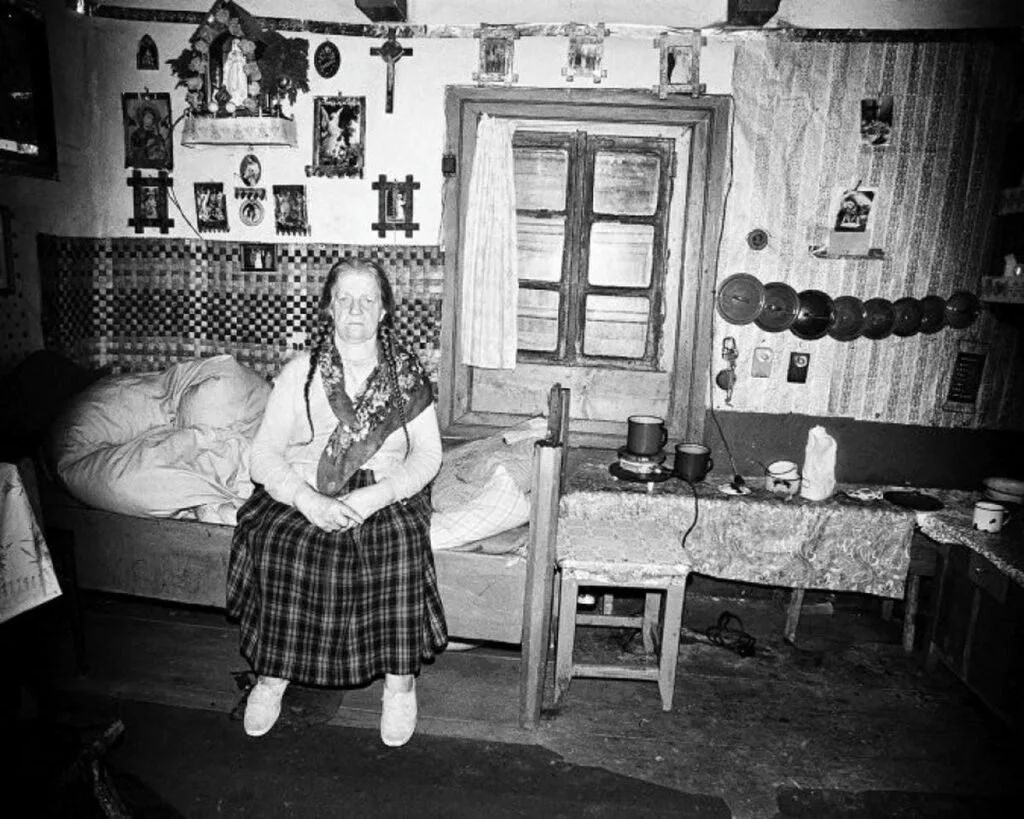
Zofia Rydet’s Sociological Record on the next floor down was the final exhibition on my itinerary and its inclusion on my list was partly motivated by personal reasons. My mother’s father was Polish, originally in the Merchant Navy when first emigrating to the UK before the war, then joining the Submarine Corps to fight against Hitler’s forces. I’d grown up immersed in my mother’s romance for her Polish roots and her father was large in her life and memory even long-after he died almost before I could form memories of him. I suspect losing her own mother at age seventeen which had left her father alone to care for her and her sister, helped to foreground him and subsequently her Polish heritage in my mother’s life.
Unlike Mikhailov’s more politically oriented work from Eastern Block Ukraine, Rydet’s images from rural Poland during the 1970’s and 80’s are gentler and domestic, but to me at least still powerfully disarming and moving in their candid nature. Curiously, the scenes which often included impeccably organised clutter and a characterful old Babushka seemed all too familiar to me. I don’t know how my now elderly bi-polar mother would have been exposed to any such scenes as she has never visited Poland, and she mentioned no prior knowledge of such images when I had told her of my plan to visit this exhibition in advance, but I have in my mind’s eye many memories of her in her own similar surroundings that could substitute for one of Rydet’s subjects. It was hard not to feel as if somehow an inexplicable cultural memory had been embodied and expressed by my mother.
Of course, these images depicted part of what was my heritage too and I found the rudimentary simplicity of these rural dwellings both fascinating and in some ways appealing, striking chords of Henry Thoreau’s Walden and the solitary poet in me that yearns to retreat to a remote cabin for a simple life of writing and immersion in a more natural rhythm of being. No doubt though, things even in rural Poland are likely very different now, and I expect the long fibre-optic fingers of capitalism reach into every corner of the country with all the good and bad provided by the infinite choices that information technology promises.
Mindful of time, I descended to the book shop in the basement (where I could easily waste hours and spend thousands) to purchase with the 20% discount voucher provided by membership the book of Rydet’s Sociological Record as a gift for my mother. The beautiful monochrome prints of Michael Kenna’s long exposure analogue landscapes in the adjacent subterranean exhibition space would have to wait until I returned to take in the Mikhailov another day.
It was then only a short walk up the steps to negotiate the crowds of Oxford Street, then Oxford Circus underground station, followed by a brief ride back to Kings Cross where I just had time to purchase a bottle of water before eventually finding a seat after walking most of the length of platform nine. With a headful of thoughts and impressions, numerous snaps on my phone as records of notable elements of the exhibitions, and a few images I’d made with my camera, I settled down in my seat with Andres Segovia playing classical Spanish guitar in my earphones and to read the Introduction to Marx I’d started the a few day’s previously, knowing that I’d need to sleep on the day’s experiences from my trip before beginning to write my account the next day.
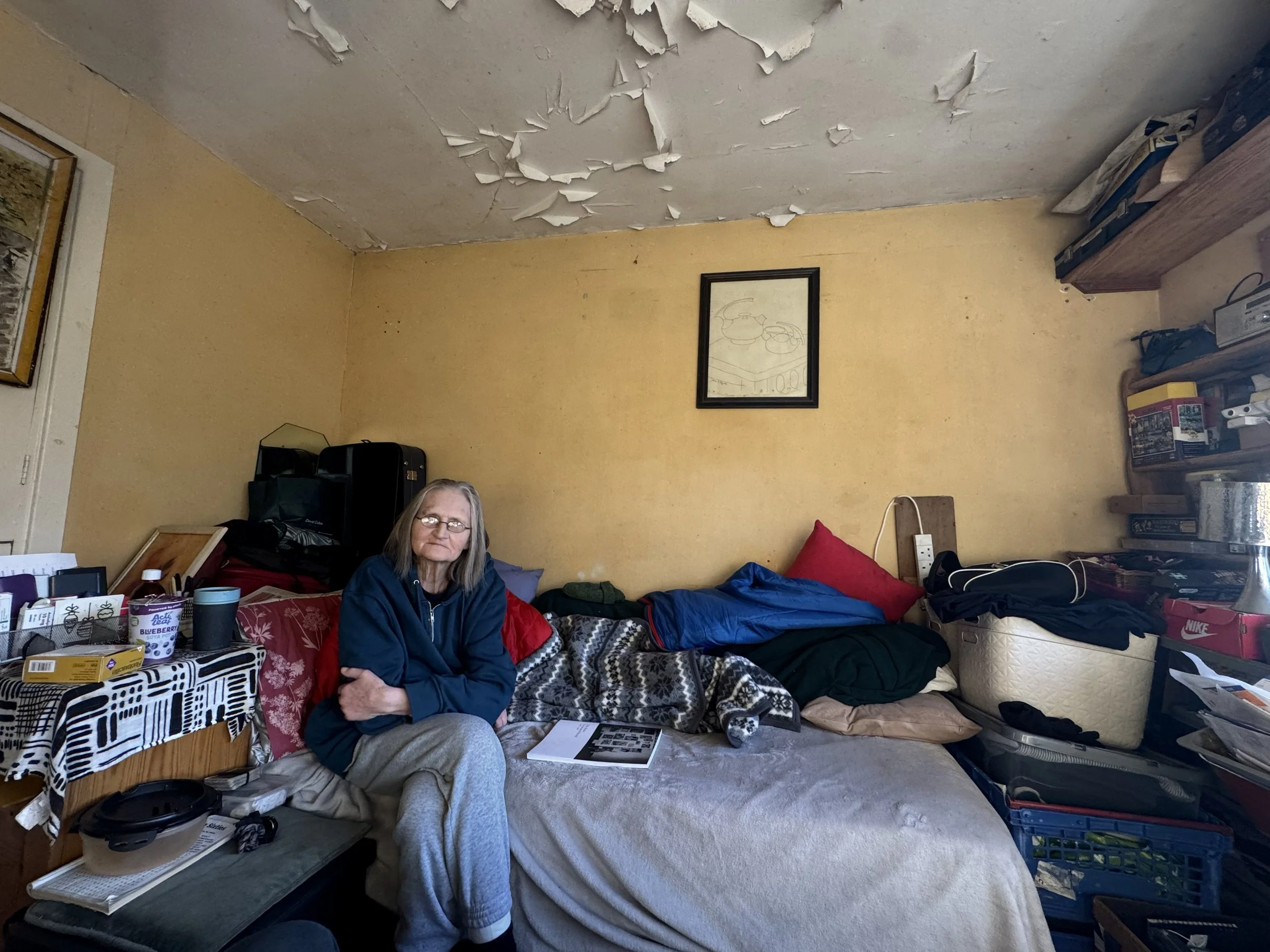
Mum (down phase), December 2025