From A to Z (Assault to Zofia), Part 2: Making, Not Taking
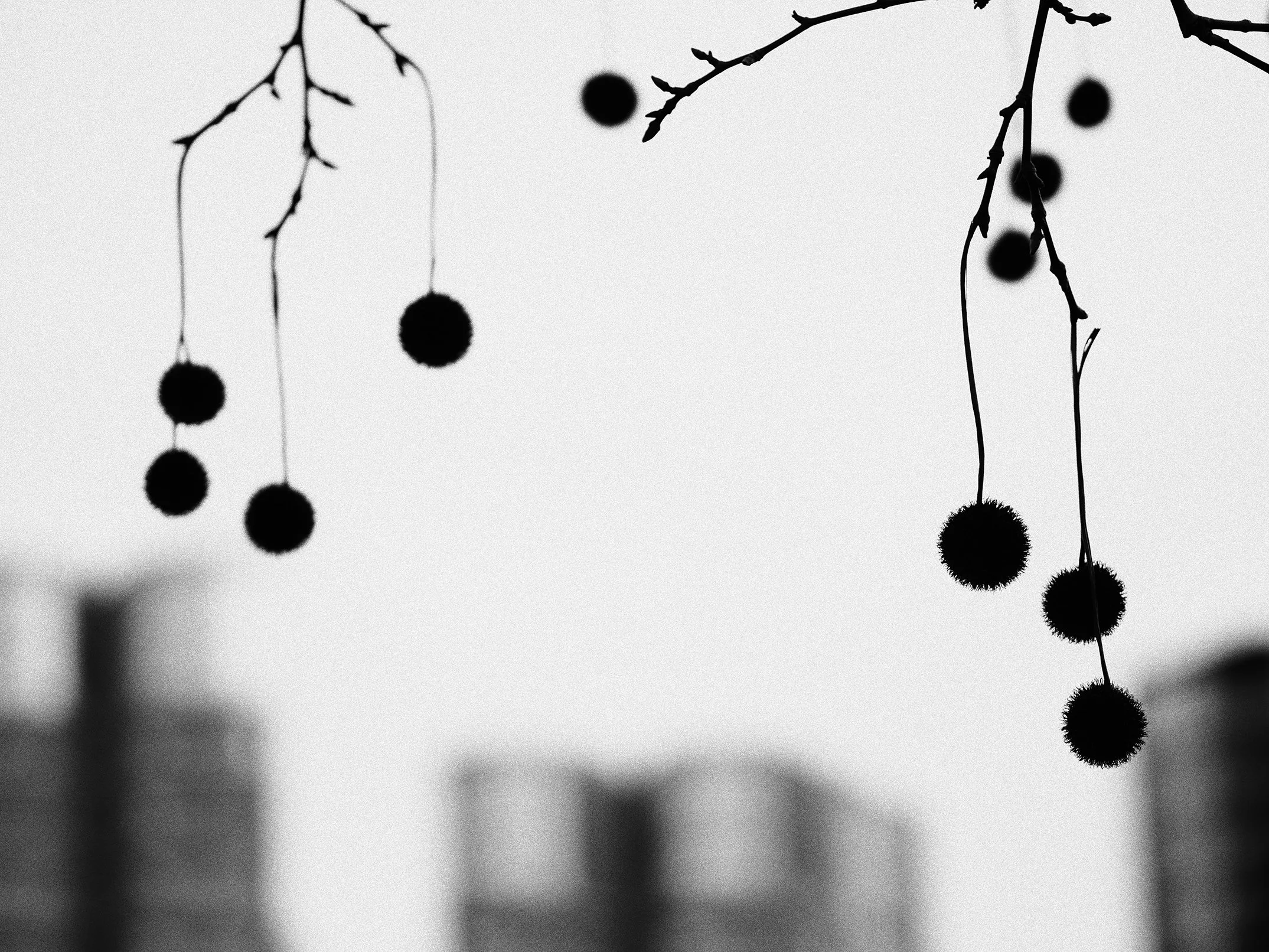
London Plane Baubles, Millbank, December 2025
Having gorged myself on Lee Miller, I welcomed the fresh air and opportunity to wander and ponder along Millbank toward my next destination. With contrast being one of the keystone elements of photographic composition in terms of both form and tonality, and myself always feeling somewhat torn between the natural (or at least the rural) environment and the cultural wealth of urban areas, I’m often drawn photographically to occasions where these two worlds overlap.
So, when I saw the seemingly perfect spheres of the brown round fruits of the London Plane trees, hanging like drab Christmas baubles over the river and against the backdrop of the geometric glass and steel high-rise buildings on the opposite bank, I just had to stop to make some pictures.
Hopefully you noted that I said “make” rather than “take” some pictures. Just as I believe it is a misconception that photography is primarily about, or more about light than it is about time, I believe it is a misnomer to talk of taking pictures. The term “taking a picture” implies that it existed in finished form waiting to be plucked like a blossoming flower by the photographer and infers an objectivity and passivity which denies the photographer the creative function of their inherent subjectivity.
Even the initial act of deciding to hold the camera to the eye to behold the potential subject through the viewfinder is a subjective act, a choice. Then considering whether to press the shutter release, or does the framing need to change first, and what about the camera settings; the exposure value, the shutter speed, the aperture, the focal length of the lens – all subjective choices that change the resulting image.
And although not every photographer, not everyone making an image with a recording device has the technical knowledge or a device with the capabilities for such comprehensive control as outlined above, even a snapshot on a phone or with a polaroid camera is made rather than taken, again because of that initial act of choosing to photograph the moment of observation that moved them enough to consider it photo-worthy, let alone physical influences of their height, relation to the subject and any other number of factors unique to each photographer and subject interaction.
As part of one of my roles in the photographic trade I had to teach people the essential technical skills of photography (my favourite part of the job to be honest). I would explain the exposure triangle and how recording media sensitivity, aperture and shutter speed function in a reciprocal relationship to achieve an acceptable exposure. I would demonstrate how the choice of shutter speed affects how movement and/or the passing of time is portrayed, and how aperture choice which influences depth of field (how much is in focus in front of and behind the primary point of focus) allows one to determine a hierarchy of value and direct the viewers’ attention to one element rather than another. I’d change lenses from wider to longer, or focal length on a zoom lens to show how this changes what one can include in the frame, or how the barrel distortion of a wide lens can be dramatic but unflattering for portraits and that a long focal length compresses perspective.
Those technical matters, those choices are key creative tools in photography that have the power to influence the outcome and meanings, or if one prefers, the variety of readings available to the photographer and the audience in the resultant image which is the nexus between the two – photograph maker and photograph viewer (who of course brings their own baggage to bear too). And this is why we must reject any notion of the photograph as an objective document.
The position that photography is purely visually representational, an objective recording, is not so prevalent now or even perhaps the dominant view such as it was at the beginnings of photography when our world had only previously been illustrated by artists via drawing, painting, and printmaking. But our language, and I would argue therefore our unconscious bias, has not caught up – taking photographs rather than making them. That bias in the early days of photography was a major barrier to it becoming accepted as an art form. A photograph was considered the result of a mechanical act bereft of the artistic skills required to produce impressive drawings or paintings.
Considering again the photographs of Lee Miller which I had just been viewing at Tate Britain, we can see how blending the unique realism of the photographic medium with explicit distortions of the subject or the image that might lead to cognitive dissonance and the sense of the uncanny (both familiar and strange) in the viewer, demonstrated the depth and range of creative potential inherent in photography as an art form and helped to elevate it from the perception as merely an act of mechanical recording.
Although I have a walk to get there, this discussion on the objectivity of the photograph is a perfect segway to the next destination on my itinerary; the National Portrait Gallery and the Taylor Wessing Portrait Prize. It may be no surprise by now to hear that I am sceptical about a photographic portrait’s ability to capture the subject’s personality. Similarly, I believe there is truth in the saying that we “should not judge a book by its cover”.
It was a chilly rather than cold day, fairly bright but also some low, heavy cloud which gave the sky some appealing drama. As I crossed Lambeth Bridge to the south side, I noticed the strident erections of the city in the distance, nestled both in the clouds above, and the leafless trees in the foreground, so I stopped briefly for another photograph. It was only after I’d finished and was walking again that I noticed another potential image I would have liked to have made - a beautiful young Asian woman, with her phone held up at eye level photographing what I assumed from her viewpoint were the Houses of Parliament.
However, I felt if I tried to photograph her now, it might seem intrusive (more so than if I’d noticed previously and simply turned from my prior composition to make the image). But also, it was a critical self-awareness around my own male gaze, and the tendency it seemed to me for men to want to capture, own, and control(?) beauty by photographing it, that played a significant role in setting the thematic course of my artistic practice these past twenty years. So instead, I filed the picture as a memory and continued to the other side of the river.
Having descended on to the Albert Embankment and now heading north again, I came across the Covid memorial, the many thousands of red hearts hand-painted on the wall with a formal invitation for those who had lost loved ones in the pandemic to record their names and dates in memory. I was instantly reminded of the installation in 2014 of 888, 246 ceramic poppies in the moat of the Tower of London commemorating the lives lost during and 100 years since the beginning of the first world war. I assumed this reference was intentional. I could clearly visualise the photographs I might make, but no doubt numerous near-identical images would have been made by others before, and I have an aversion to cliché. I also have concerns about being voyeuristic; a vulture feeding on carrion. Another picture filed for the mind’s eye of memory though.
As I neared Westminster Bridge the density of human traffic increased and I had to thread my way thereafter through the international tourists and the families visiting the area; The Paddington Bear Experience, Sea Life, and London Dungeon, before passing under the spidery space-age architecture of the London Eye. As I write this account on Boxing Day, and perhaps because I watched the film Oppenheimer on Christmas evening, I now recall the thronging crowd as if it were comprised of thousands of excited atoms bouncing around having been charged by some external energy force. Perhaps I too was just another excited atom, rather than the hero of my own story.
Reaching the steps up to the Hungerford Bridge and seeing the underpass occupied by a bustling Christmas Market, I quickly abandoned any desire to make a diversion to the South Bank beyond. Despite my fondness and nostalgia for that area containing the Royal Festival Hall, National Theatre, Hayward Gallery and some might say rather incongruously (amongst the High Culture) a skate park, time was ticking away, and by this point, it made no sense to take the optional, extended route further along the South Bank to cross back north of the river over the Millenium Bridge from Tate Modern towards St.Pauls.
I stopped a couple of times crossing the bridge to photograph the view south down the river including the London Eye and the distant high-rise skyline, but primarily because the dramatic clouds and low, winter afternoon sun added interest, otherwise I would not have bothered. I also felt compelled to stop again nearing the end of the bridge however as I noticed the dramatic triangular spike of the foot bridge’s suspension architecture in contrasted with the arc of a much older piece of adjacent construction. I made a few images with varying compositions and was glad that I noticed, and was able to react quickly enough to capture a bird in flight that serendipity provided when framing one of the variations.
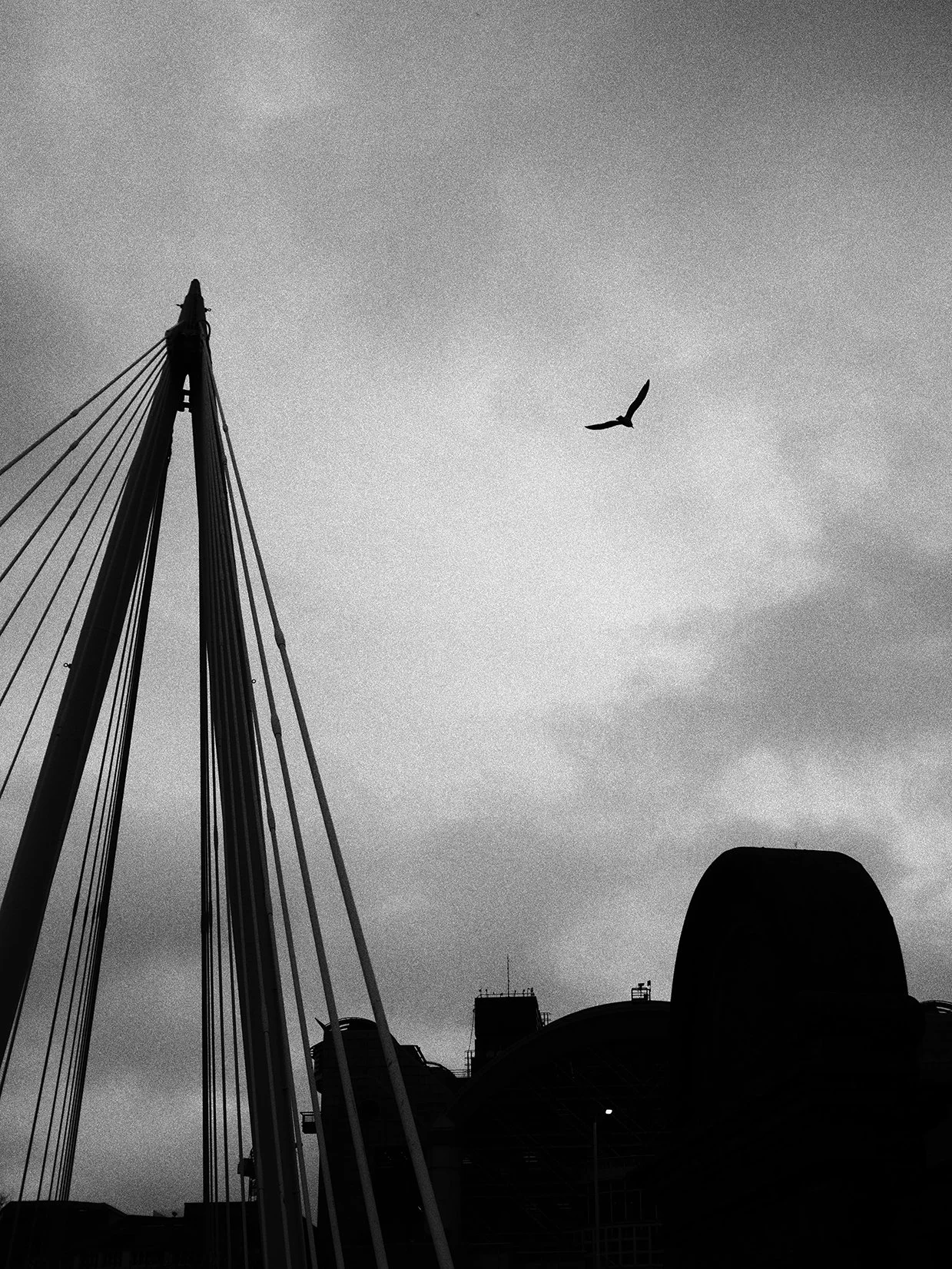
Architectures from Royal Jubilee/Hungerford Bridge, December 2025